Review: Violent Circumstances at the Blue Elephant Theatre

Susannah Cann started writing Violent Circumstances in response to the murders of Sarah Everard and Sabina Nessa in 2021. Since then, the piece has remained just as topical; the murders of Ashling Murphy, Lily Sullivan, Zara Aleena, Emma and Lettie Pattison and countless others have made headlines in the last twelve months, while who knows how many more women have suffered abuse and violence that never made the news. This violence is nothing new, of course, but it’s hard not to feel helpless in the face of its continued prevalence. That helplessness and anger led to the creation of Violence Circumstances.

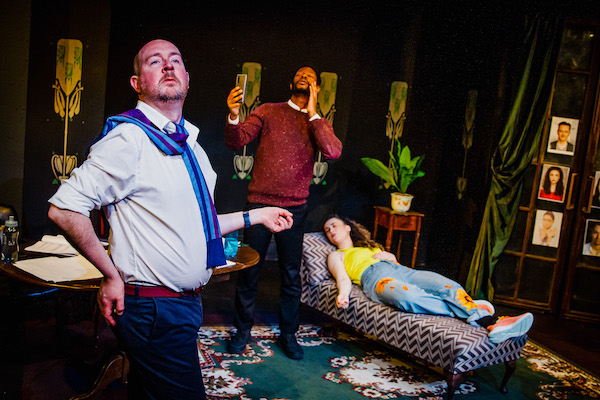
The play is actually made up of four short plays, linked by the common theme of violence against women and girls. In The DJ Thinks I’m Smashed, a young woman (Cat Thomas) is enjoying a night out at a club, but when she’s parted from her friends and her drink gets spiked, the evening takes a dark turn. In How Old Was I When We Met? we witness a phone conversation between two friends – it’s never explicitly stated but it’s implied that they’re ex-lovers – as one (Annabel Lisk) learns to her horror that the other has had a sexual encounter with an underage girl… and there’s video. Not All Men sees two sisters (Phoebe Shephard and Cat Thomas) argue about the validity of the “not all men” argument. And in I Never Gave It Much Thought a woman (Susannah Cann) remembers her walk to work one dark winter’s morning, and the events that turned this ordinary day into anything but.

In covering four very different angles of the same topic, Cann – who also directs – makes a powerful point about the many different ways in which women can find ourselves at risk. Whether we’re walking to work, or on a date, or enjoying a night out with friends, or at the shops, or at home with our family, the chance of violence – and our awareness of that chance – is never far away. The four pieces are all extremely well performed by the cast, and though they’re all no more than ten minutes long, the characters are for the most part well written and easily relatable. The first and last stories are particularly haunting, for obvious reasons, but the other two play an equally important role in raising awareness for both male and female audiences.

As society continues to search for ways to prevent the continued violence women and girls suffer every day, Violent Circumstances offers its creators and audiences an outlet for the anger and fear we all live with. It’s an important play that deserves to have a future and to be seen and heard by more people – because in this particular fight, every little helps.

Violent Circumstances was performed at the Blue Elephant Theatre on 23rd and 24th February. For details about future performances, follow Act!ve Bitch Face Theatre on Instagram: @activebtchfacetheatre and Twitter: @abftheatre

Review: Maud at Vault Festival

Tomorrow will be the third anniversary of the “modern day lynching” of Ahmaud Arbery, a 25-year-old black man who was shot dead in Georgia in February 2020. Arbery was out jogging in the neighbourhood of Satilla Shores when he was pursued by three white men in trucks, who later claimed they believed him to be a burglar. After several minutes, one of the men assaulted Arbery with a shotgun before shooting him three times. The shocking crime and the way in which it was handled by the US legal system made headlines across the world, and though Arbery’s killers were ultimately brought to justice, the case reignited the ongoing debate about racism in the United States.

Photo credit: Lidia Crisafulli

Maud is a verbatim play written by Jeffrey Miller and directed by Andrew French, which examines the murder of Ahmaud Arbery in detail, but also places it within a wider social and historical context. Performed by Miller and Perry Williams, the play is made up of excerpts from police interviews and trial testimony, along with audio and video footage of this and other crimes – among them the murder of George Floyd, which took place just a few months later. Interspersed with these are the familiar words of then-president Donald Trump, the powerful speech given by James Baldwin at a Cambridge University debate in 1965, and a 1982 interview with the Imperial Wizard of the Ku Klux Klan, Bill Wilkinson. The point is clear: the murder of Ahmaud Arbery in 2020, while shocking, was perhaps not all that surprising. The play invites us to honour his memory, along with that of George Floyd, Botham Jean, Tyre Nichols and countless others, by listening to their stories, re-examining our own prejudices, and recognising the bigger picture that unites them all.

Video footage, projected on to the back of the stage, is used to powerful effect throughout; although the attack on Arbery is described in detail during the play’s opening minutes, it’s the video taken by one of his killers that really brings home the full horror of what happened. Similarly, the animated map that precedes it forces us to imagine the final terrifying minutes of his life as he was chased through the streets by armed assailants.

Photo credit: Lidia Crisafulli

Perry Williams was a late addition to the cast after Jak Watson was forced to drop out due to illness, but you’d never know it from his assured performance. The fragmented nature of the play and the wide range of voices it draws upon calls for a significant amount of versatility from both actors, with the added pressure of knowing all those voices belong to real people. Williams’ portrayal of James Baldwin is a standout moment, and Miller’s Donald Trump is, if anything, a bit too accurate; you know an impression is good when you have the same visceral reaction to it as you do to watching the man himself.

Maud is a powerful and considered piece of theatre, and while in parts it could use a bit more polish, its foundations are undeniably strong. The careful selection of material and the ways in which it’s presented have a lot of impact, especially when coupled with solid performances and the choice to step back and allow some key voices – among them those of Ahmaud Arbery’s mother and sister – to speak for themselves. Recent headlines have shown that racist violence against Black Americans isn’t going away, and however hard they may be to watch, we need shows like Maud to keep speaking out against it, and encouraging others to do the same.

Maud is at Vault Festival until 25th February.

Review: The Play With Speeches at Jack Studio Theatre

“Complicated, isn’t it?” says one of the characters early on in James Woolf’s The Play With Speeches – and they’re not wrong. As writer Anthony (Matthew Parker) sits down with director Penny (Katherine Reilly) to audition actors for his new play, they discover to their surprise that someone’s been selling tickets, and now they have an audience (us). To make things more complex, the play itself is made up of audition speeches from a selection of fictional works which, when read in the right order, tell an original story. And so we find ourselves an unexpected audience to actors who are auditioning by reading audition speeches which are also part of the play they’re auditioning for. Complicated, isn’t it?

Photo credit: Bec Newman

Fortunately, this play within a play within a play (I think?) is also very entertaining, made even more so by the fact that Anthony and Penny used to be a couple, and are now very much not one. As the evening goes on, and Anthony warms to our presence in his audition room, more and more details are “ventilated” about their relationship and its messy conclusion, and it becomes obvious just how much his work has been influenced by his bitterness towards his ex. Meanwhile a series of hapless actors try out for a part; all of them are very good, so any decision on whether they will or will not be selected is based purely on the whim of the panel – and as we quickly discover, neither is shy about voicing their opinions or making snap judgments.

The surprisingly extensive cast of nine are all excellent, with stand-out performances in particular from “auditionees” Anna Blackburn as the flirtatious Bambina and Camilia O’Grady as a panic-stricken Alice. Jumaane Brown is also brilliant as Anthony and Penny’s harried assistant Nick (also known, it transpires, as Jez) and Katherine Reilly – who, as if the production wasn’t meta enough already, also co-directs with Ursula Campbell, who herself plays auditionee Michaela – exudes the perfect amount of weary resignation as Penny, in direct contrast to her flamboyant collaborator. But the stage belongs, just as his character would wish, to Matthew Parker, who is clearly having the time of his life as the pompous, conceited Anthony. His every overblown gesture and exaggerated facial expression lifts the comedy to a new level, and by the end of the show he’s even managed to make the awful Anthony into a sympathetic figure who has the audience (almost) completely on his side.

Photo credit: Bec Newman

The play is essentially made up of one long scene, and its brisk pace rarely falters – with the exception of one awkward moment where a volunteer from the audience is called for, and everyone automatically looks away. Apart from that, the laughs come thick and fast, with several jokes directly poking affectionate fun at the theatrical process and the people who take part in it. The Play With Speeches is a clever, multi-layered comedy that provides instant humour but also plenty to try and wrap your brain around on the journey home. All in all, it’s good, silly fun with a fantastic central performance. What’s not to love?

The Play With Speeches is at the Jack Studio Theatre until 4th March.

Review: A Funny Thing Happened On The Way To The Theatre… at Chickenshed

Returning to the Chickenshed studio for 2023, the North London theatre’s annual showcase of new writing focuses this year on the theme of storytelling. Unlike previous years, there’s no single opportunity to see all nine plays in one go, so each performance consists of four or five short pieces, each very different but all equally promising, which take the audience on a rollercoaster of emotions. Last night I saw four: Feedback by Sebastian Ross, All Too Seeing by Idil Aydinli, My Mother Once Asked Me by Sara Chernaik and Dark Immortal by Cathy Jansen-Ridings.

First up was Feedback, in which the successful but wildly insecure writer and director (Daryl Bullock) of a five-star, smash hit play happens to get stuck in a lift with the one person who was underwhelmed by her “experience” (Ellie Morton). As a reviewer, the play presents a slightly nerve-wracking scenario – although in this case, the dissenting voice isn’t a critic but just a regular member of the public who found herself at the theatre by chance. She can’t understand why her opinion matters so much in the face of such critical acclaim, and he’s convinced she must have an ulterior motive for slandering his creation – well, that or she’s just too stupid to understand it. Under Beth Fox’s direction, the broken down lift predicament heightens the tension nicely, and although the piece in general is very funny, it also asks some really interesting questions about the nature of criticism and who deserves to have a voice when discussing art.

All Too Seeing by Idil Aydinli. Photo credit: Elia Criscuoli

All Too Seeing, which is written, directed and performed by Idil Aydinli, is an extraordinarily powerful piece about a young woman who’s spent years cultivating a public persona as the life and soul of the party, the epitome of confidence and competence. But behind the scenes things are very different, and as she struggles to come to terms with a recent loss, she realises that perhaps her secrets are no longer hidden from the one person whose opinion always mattered the most. As the play goes on, the lines between her two world begin to blur, and it becomes harder to distinguish what’s really happening from what she wants us to see. It’s incredibly well written and performed, and the direction is extremely clever; this definitely feels like a piece that could go on to bigger things.

My Mother Once Asked Me is in some ways similar, in that it also looks at how we deal with loss, but presented very differently. Directed by Paul Harris, the protagonist (Julie Wood) greets us from her armchair, where she sits reflecting on a conversation she once had with her mother. This memory sparks another, and another – building up into a patchwork of nostalgia that ricochets from one story to the next. The play doesn’t flow in the usual narrative sense, and can at times get a bit confusing as we try to remember if we’ve heard of this person before, or what the connection was with that name. But ultimately, it all comes together in quite a lovely way, with a reminder that though we may lose loved ones, they’re never really gone, and that how we choose to remember them is a deeply personal choice.

Our evening concluded with the delightfully silly Dark Immortal. Directed by Sebastian Ross, it’s easily the most ambitious of the four pieces I saw in terms of effects and costumes, and sees a depressed Dracula (Paul Harris) realising that immortality may not be all it’s cracked up to be. Luckily his loyal and long-suffering servant Ana-Marjena (Sarah Driver) has a plan, and calls on her friend Gabriel D’Angelo (Benedict Lawson) to try and cheer her boss up. Unsurprisingly, things don’t turn out quite as she intended – but even in the presence of pure evil, there are plenty of laughs to be had as Gabriel gamely soldiers on in his attempts at therapy. I can imagine this piece being developed into a longer show; I’d definitely watch it, as there’s bags of potential in the dysfunctional relationships between the characters, and it felt like we were only just getting to know them when the play ended.

Dark Immortal by Cathy Jansen-Ridings. Photo credit: Elia Criscuoli

I can’t speak for the remaining five pieces*, but if their quality is as good as those I saw last night, anyone seeing them is set for a great evening. As ever it’s fascinating to see how different writers interpret the same theme, through laughter or tears, fantasy or deeply personal reality. And it’s good too to see the annual performance of new writing at Chickenshed continuing to grow and develop from year to year. More please!

A Funny Thing Happened On The Way To The Theatre… continues at Chickshed until 18th February.

* The other five pieces are Bullet in My Heart by Rebecca Hardy, Spectrum by Hussain Raza, Rallying Cry by Julie Dogliani, Storytelling by Carmel Gayle, and Good To Be Alive by Paul Harris.

Review: David Copperfield at Riverside Studios

As adaptations go, they don’t come a lot more ambitious than Simon Reade’s reimagining of David Copperfield. The semi-autobiographical novel by Charles Dickens is known for its expansive cast of characters, and this production sees all of them played by just three actors. Set against the backdrop of a Victorian music hall, this creative and enjoyable ride through the life of Dickens’ favourite character showcases the performers’ versatility and stamina, while providing plenty of laughs along the way.

Photo credit: Christian Davies

David Copperfield (a thoroughly engaging Christopher Buckley) narrates his own tale from birth to adulthood, introducing us to a host of colourful characters from his stern aunt Betsey Trotwood to the kind-hearted Clara Peggotty and her family, the financially incompetent Mr Micawber to beautiful Dora Spenlow. All of these and more are portrayed by Katy Owen and James Peake, who are clearly having a lot of fun as they swap gender, class and personality to bring these friends and acquaintances to life. For the most part these characterisations are easily distinguishable from each other thanks to the quick donning of a hat or a scarf, or the adoption of a particular posture or accent, and the audience quickly becomes familiar with the recurring characters as they pop up again throughout the story. This makes the production in general very accessible to all, although a couple of the characters are so extreme that it does feel like you need to know the source material to fully understand what the actors are going for.

At just two hours running time, there’s a lot of story to get through, and the pace of Emily Raymond’s production is fairly breakneck, with David seemingly going from school to home to factory to his aunt’s house all in the space of about ten minutes. The Micawbers have barely been introduced before they’re leaving again (their protracted departures becoming a running joke that ultimately begins to wear a bit thin), David’s second marriage happens literally in the blink of an eye, and even the villainous Uriah Heep only gets one scene – though that one scene is certainly memorable. That said, at certain key moments this pace does ease and the story is allowed time to breathe; the plight of the Peggotty family in Norfolk is one such example, as is Mr Dick’s “trouble” with King Charles I and his attempt to ease it by flying kites. The show is also punctuated by musical numbers, written by Chris Larner and performed by the cast with piano from musical director Tom Knowles, which add little to the plot but are catchy and enjoyable enough.

Photo credit: Christian Davies

For those not familiar with the’ novel, David Copperfield is an entertaining introduction which will make you want to go away and read it. For those who already know the story, it’s a warm welcome back to much-loved characters, and a whistlestop but faithful adaptation of the original. The production has humour and heart (not to mention a few surprises) and honours both Dickens’ creation and his love for the theatre in a charming piece of storytelling.

David Copperfield continues at Riverside Studios until 25th February.