Review: Equus at Trafalgar Studios

Peter Shaffer’s Equus begins with a disturbing image: a seventeen-year-old boy, Alan Strang, has been referred to the care of renowned child psychiatrist Martin Dysart after blinding six horses at the local stables. And things don’t get much easier from there in this intense drama; Dr Dysart slowly pieces together what led the young man to commit such an act, but questions as he does so if treating Alan will actually help him, or only condemn him to a life as empty and meaningless as the doctor’s own. Touching on themes of religion, sexuality and more than one form of mental illness, the play asks some difficult questions and frequently makes for unsettling viewing, and yet Ned Bennett’s production remains utterly compelling from start to dramatic finish.
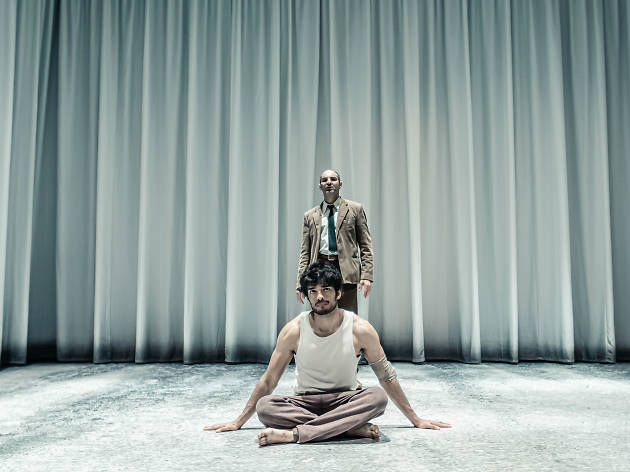
Photo credit: The Other Richard

The cast of eight are left completely exposed on Georgia Lowe’s barren, starkly lit stage (though don’t let its simplicity fool you – it still produces a few surprises later on). Fortunately, the performances of all involved are engrossing enough that the audience’s attention never wanders, despite more than one lengthy monologue. Ethan Kai and Zubin Varla take centre stage as patient and doctor – the former a picture of wild and confused defiance, the latter of quiet, building desperation – locked in a battle that both know neither can win. Though the play’s core plot is to solve the mystery of Alan’s crime, there’s just as much to unpick in Dysart’s surprising response to the latest in a seemingly endless line of troubled adolescents.

Alongside the two excellent leads, there are strong performances across the board, with Ira Mandela Siobhan particularly mesmerising as Alan’s favourite horse, Nugget. The detail, power and physicality in his portrayal, combined with Shelley Maxwell’s exquisite choreography, is such that there’s no need for any masks or costumes to convince us we’re looking at a magnificent stallion – and by dispensing with these, Bennett further blurs the lines surrounding Alan’s confused sexual desires.

Photo credit: The Other Richard

Though the play at times leans towards becoming text-heavy, with Dysart in particular reflecting at increasing length on his own misery, in fact the production strikes a good balance that prevents it ever becoming dry or losing its energy. More than once a character’s monologue is punctuated by light and sound effects that have obviously been designed (by Jessica Hung Han Yun and Giles Thomas respectively) to unsettle our minds and, occasionally, our nerves. The tension creeps up as we draw closer to the play’s climax, and although the actual blinding of the horses is enacted without a trace of gore, the moment of impact still hits powerfully home, both on and off stage.

And besides – it’s not such a trauma to listen to Shaffer’s words, especially when they include such hauntingly evocative gems as, “A child is born into a world of phenomena all equal in their power to enslave… Moments snap together like magnets, forging a chain of shackles.” Lines like this one, a potent reminder of how easily and arbitrarily mental illness can strike, ensure that despite being close to 50 years old, Equus continues to have plenty to say.

Equus is at Trafalgar Studios until 7th September.


Can’t see the map on iPhone? Try turning your phone to landscape and that should sort it. I don’t know why but I’m working on it… 😉

Review: Katheryn Howard at Brockley Jack Studio Theatre

When it comes to Henry VIII’s wives, the key fact that most people learn at school is how he disposed of them. In the case of Katheryn Howard, his fifth wife, this was at the executioner’s block, after she was accused of adultery with one of the king’s favourite courtiers.

Written by Catherine Hiscock, the debut production from Goose Bite Theatre picks up the story of Queen Katheryn close to the end, as an all-female cast portray a court filling with rumours – not just regarding her reported liaisons with Thomas Culpepper whilst married, but also previous sexual relationships with her music teacher Henry Mannox and secretary to the Dowager Duchess, Francis Dereham. Once these well-documented facts have been established, the play takes us back to the start to give us Katheryn’s account of these events, and a very different picture emerges.

Photo credit: Georgia Harris

The first piece of information I don’t remember learning in primary school is that Katheryn Howard was only a teenager at the time of both her marriage and her death, and each of the men with whom she was reported to have been involved – including her husband – were more than twice her age. The second little-known fact is that she could have saved herself by confessing that her relationship with Dereham was consensual, and yet despite the possibility of salvation, she continued to insist that he had raped her. The Katheryn we meet in this production (Catherine Hiscock) is not the adulteress we know from the history books, but a naive, terrified teenager who’s repeatedly found herself flattered and seduced into unwanted sexual relationships with predatory men. Seen through fresh eyes, and particularly from a 21st century perspective, her story is not just tragic but horrifying.

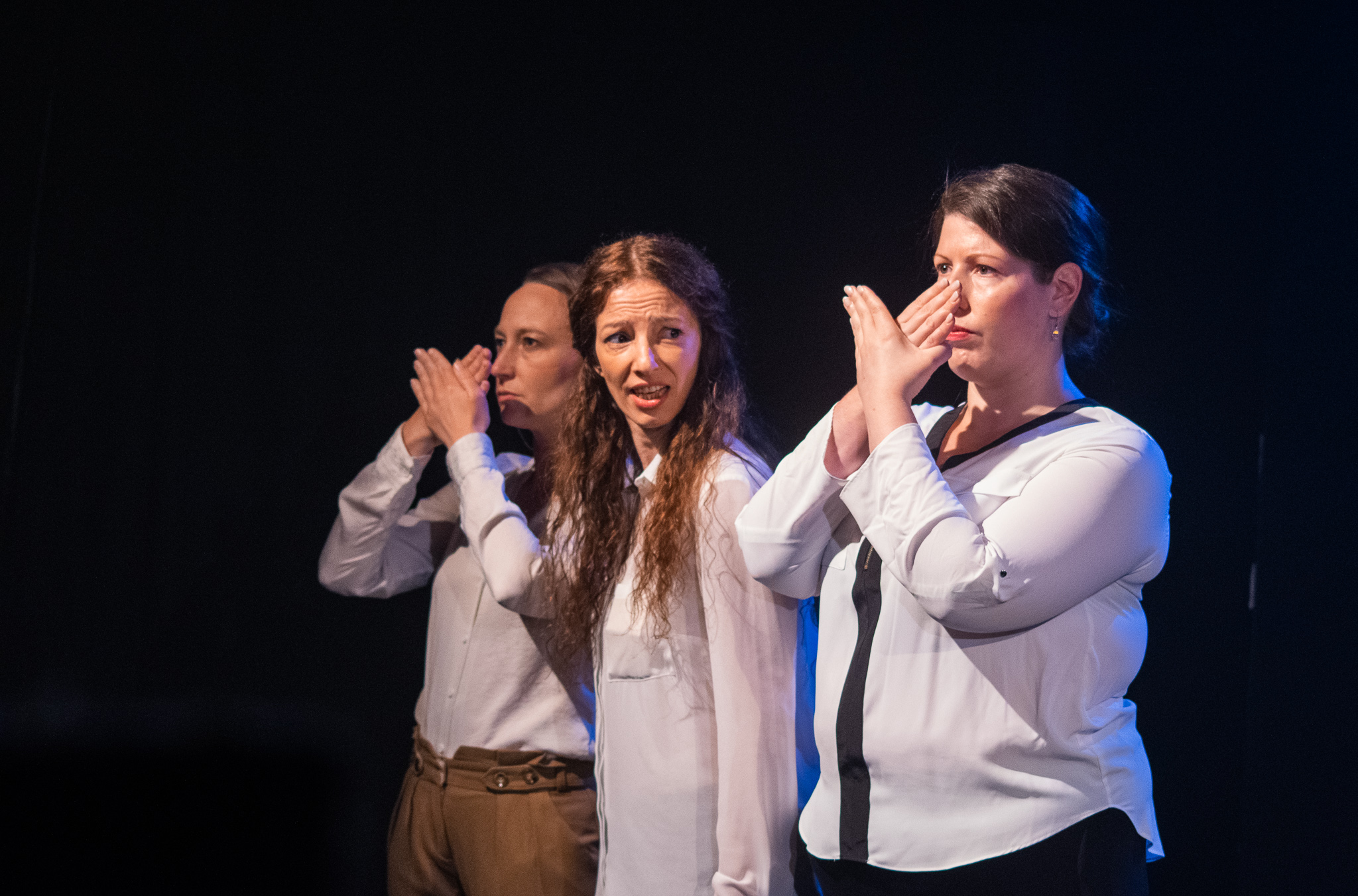
Surrounding Katheryn are her friends and ladies-in-waiting: Joan Bulmer (Francesca Anderson), Katheryn Tilney (Emmanuela Lia), Isabelle Baynton (Srabani Sen) and Jane Boleyn (Natalie Harper) – Anne Boleyn’s former sister-in-law, who allegedly aided and abetted Katheryn’s adultery and was executed immediately after her. The interactions between these characters paints a picture of life both at Lambeth, where Katheryn spent her childhood and early teenage years, and at court, where everyone’s number one concern is to protect their own position. Though it covers a relatively brief time period, the production captures very well the stark contrast between the giggling girls of Lambeth, for whom it’s common practice and seemingly harmless fun to welcome young men into their sleeping quarters, and the anxious ladies of court, who quickly realise that the queen’s downfall could also spell their own doom. This atmosphere of paranoia, suspicion and political manoeuvring is portrayed by the cast in the form of a chorus, who pace the stage with hands to their mouths as if whispering secrets.

Photo credit: Georgia Harris

You perhaps need to know a little bit more of Katheryn’s back-story than simply “beheaded” to follow everything in the text, but on the whole the play does a good job of untangling a complicated story in which many of the characters have the same name (to the point where it becomes something of a running joke) and/or are related to each other. And Catherine Hiscock gives a great performance as the young queen; her pleas for mercy and forgiveness as the play comes to an end are heartfelt and deeply poignant. It’s no surprise that women were second-rate citizens in Henry’s court, but it’s frustrating that even now we still only really know Katheryn by the manner of her death. This play sets out to right that wrong, and the result is a strong debut production that’s both historically interesting and emotionally impactful.

Katheryn Howard was performed at the Brockley Jack Studio Theatre from 30th July to 3rd August. For more details about Goose Bite Theatre, follow them @GooseBiteTC.