Review: Frankenstein at the Royal Exchange Theatre

Guest review by Richard Hall

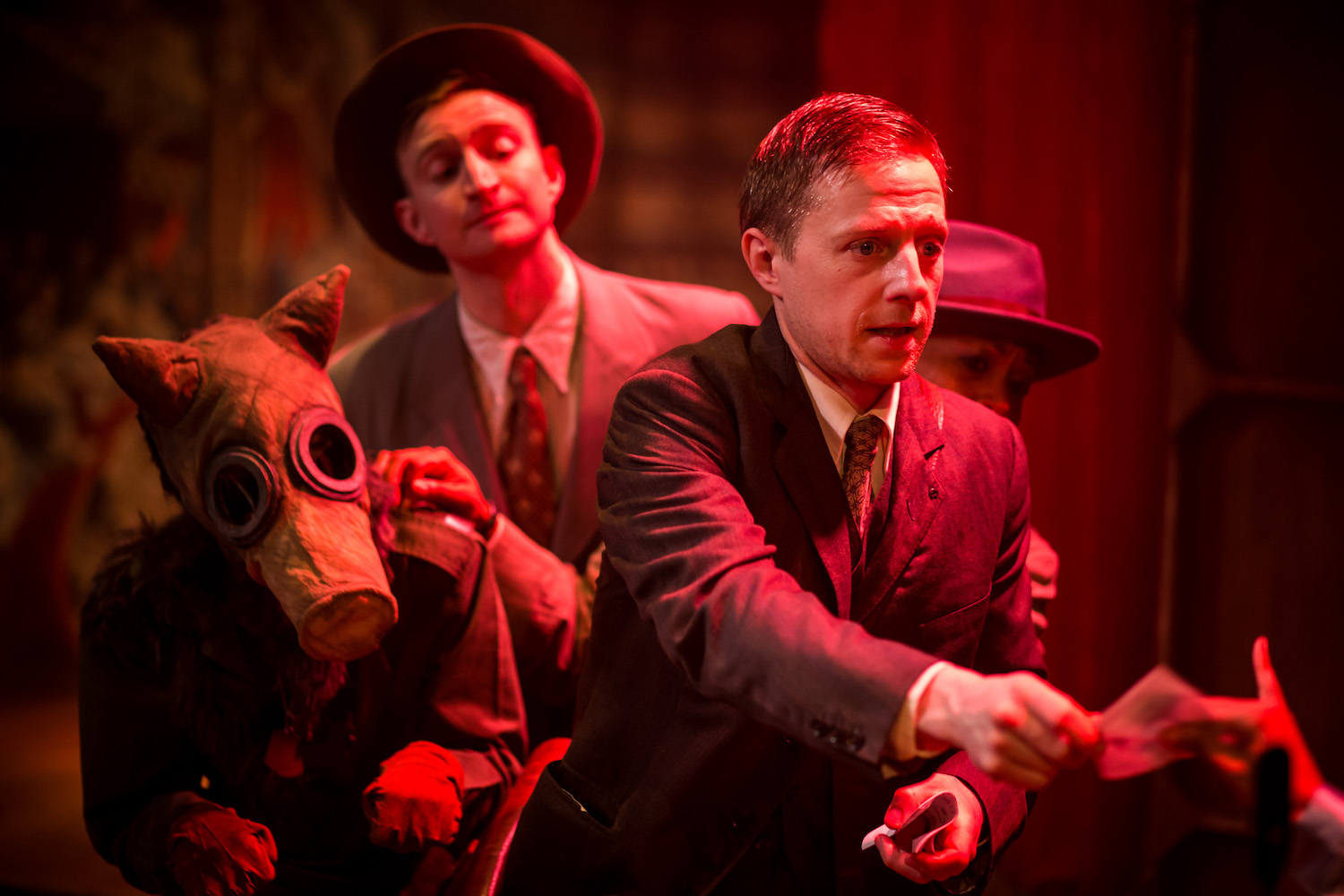
There has been a lot of hype surrounding this production with some if it promising “on-stage depictions of murder gore and dismembered body parts”, and in a recent interview, director Matthew Xia openly stated that he wanted to present “a nightmarish, fractious dream state … and scare the audience”. Over a longish two and half hours what emerges is less of a horror show and more a faithful realisation of the Gothic and Romantic elements of Shelly’s novel, first published 200 years ago when the author was just nineteen. Although the production does contain some fleeting moments of shock horror, they are for the most part muted and lack any real power and intensity to have a disturbing or unnerving effect.

As with the novel, April De Angelis’ new adaptation starts with a naval officer, Captain Walton, recounting the story in the form of letters written to his sister, whilst he and his crew are trapped in a mountain of ice near the North Pole. De Angelis’ intelligent adaptation cleverly combines the novel’s epistolary form with multi layered flashbacks which act as a perfect framing device for the production.
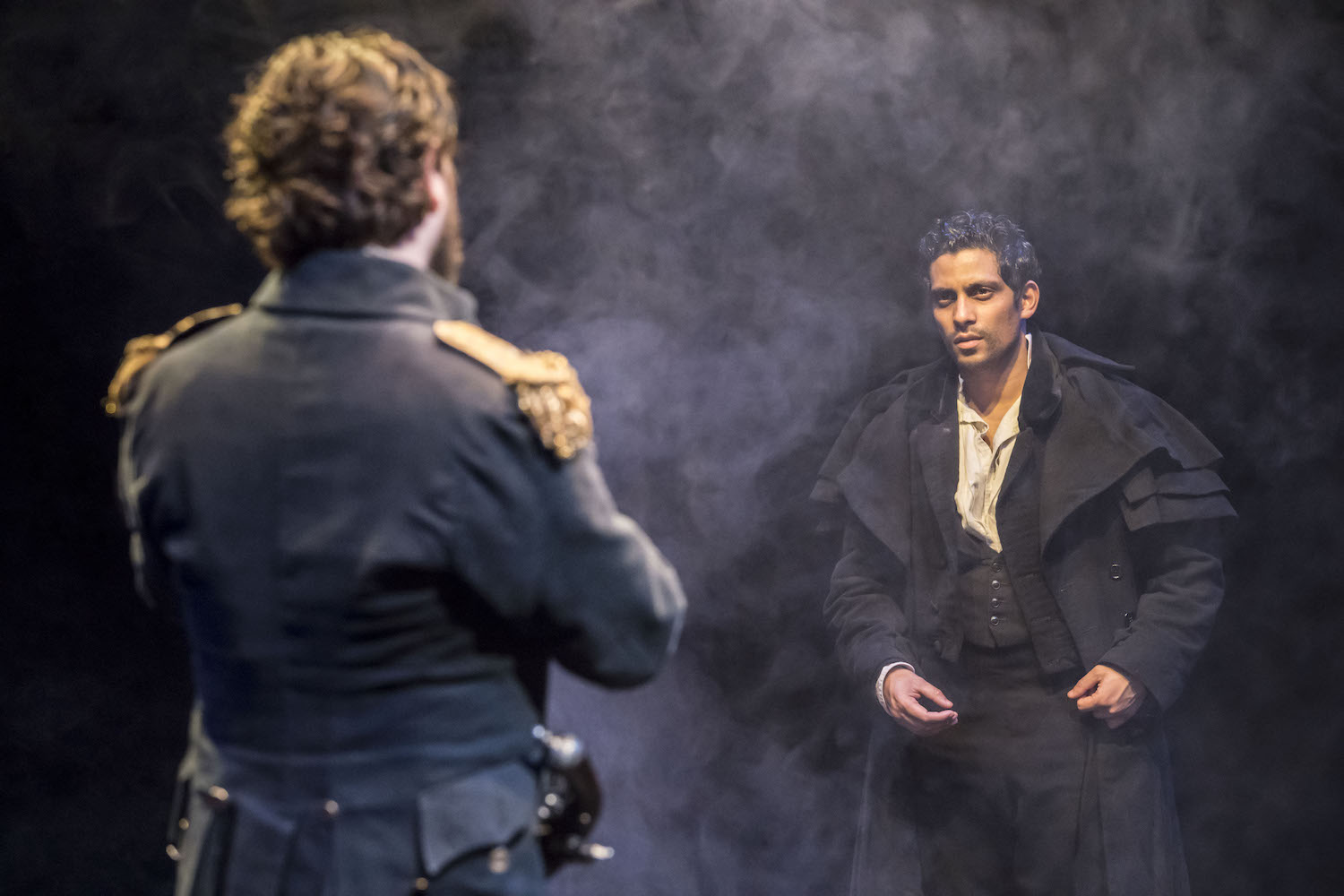
Photo credit: Johan Persson

Discovered wandering out of his mind in the frozen wilderness, Victor Frankenstein is rescued by Walton and with no one on board that he can confide in, he sees the disturbed young doctor as someone he can befriend. Walton cajoles Frankenstein into telling his story and for the most part he watches silently in horror as the Doctor relates how from an early obsession with death he succeeded in creating and bringing to life a monstrous being. This monster it transpires is responsible for the death of those that Frankenstein has loved and held dear in his life, including his best friend, wife and younger brother.

Essential to any successful production of Frankenstein – and there have been a few notable ones in recent years, memorably Danny Boyle’s 2015 production at the National Theatre – is the casting of the two lead roles. Victor Frankenstein is a role that cries out for an actor that can bring to it bags of charisma and energy but Shane Zaza, a highly experienced and respected stage actor, sadly fails to convince in the role, looks uncomfortable and gives a one note performance that is mannered and limited in both dramatic and vocal range.

As the monster, Harry Attwell fares much better and the over long first half only bursts into life when he appears. Although I am sure the look of the monster has been thoroughly researched and designed to be true to the spirit of the novel, unfortunately a badly fitting wig/head piece and billowing costume makes Attwell’s monster look more like an absurd cross between the veteran actor and comedian Max Wall and the beast in Disney’s classic animated fairy tale. Despite this however, Attwell gives undoubtedly the finest performance of the evening and in denouncing Frankenstein and his manipulation of science and the natural order, he voices both 19th and 21st century concerns about wealth, poverty, injustice and the plight of the downtrodden. Although guilty of many heinous acts against Frankenstein and his family, it is difficult not to feel some sympathy and a degree of empathy for Attwell’s monster.

Photo credit: Johan Persson

Led by Ryan Gage’s excellent and assiduous Captain Walton, a hard working cast play multiple roles as the story of Frankenstein’s adventures slowly unfold and are played out in a number of settings including Geneva, the remote Scottish Isles and much to the amusement of the first night audience, Derby. It is difficult to pin point why this production does not work in the way that Xia and the surrounding hype had intended. Although the Royal Exchange employs the full range of special effects in its armoury, including real rain water and pyrotechnics, the overall feeling is of a somewhat subdued, lacklustre production that looks great but contains little tension to drive the drama forward.

There is however still much to enjoy in this production, especially Ben Stones’ sparse but effective and innovative set, Mark Melville’s pulsating and thrilling sound design and Johanna Town’s stark and atmospheric lighting – but for genuine theatrical shocks and thrills, a visit to see Susan Hill’s masterly The Woman In Black either in the West End or on tour is recommended instead.

Review: Checkpoint Chana at Finborough Theatre

It sometimes feels like barely a day goes by without someone in the public eye saying or doing something ill-advised, only to back down under the inevitable public outcry and issue a hastily written apology. This is the situation in which we find Bev Hemmings (Geraldine Somerville), the central character in Jeff Page’s Checkpoint Chana. Her latest collection of poems has just been published, with one particular piece attracting widespread attention and criticism for a line that many view as anti-Semitic. Even Bev’s loyal PA Tamsin (Ulrika Krishnamurti) isn’t quite sure how she feels about it, but she throws herself nonetheless into damage control – a task made more tricky by the fact her boss doesn’t think she’s done anything wrong.

Photo credit: Samuel Kirkman

And the truth is that for all her many faults, Bev seems far more guilty of poor judgment and extreme naivety than of any actual prejudice. She doesn’t want to apologise because she didn’t mean any harm – and looked at from an entirely rational perspective, she might have a point. Except when it comes to anti-Semitism, taking emotion out of the equation is a very difficult thing to do, and it’s her failure to appreciate the strength of feeling on both sides that’s brought Bev to this point. This, along with a dying father, a serious drink problem (as the play opens, she swigs wine surreptitiously from a hot water bottle – an odd addition from director Manuel Bau, given that Bev’s love of booze is soon revealed to be an extremely open secret) and a career that’s hanging by a thread, provides us with plenty of reasons to pity rather than condemn her, should we choose to do so.

Despite appearances, Checkpoint Chana isn’t a particularly political play, and anyone hoping to engage in sturdy debate about the Middle East is likely to come away feeling unsatisfied. Page steers clear of discussing the historical background to the furore, choosing instead to focus on Bev’s personal turmoil. Geraldine Somerville perfectly captures the complexity of her character, making her pathetic enough that we find it hard to hate her, but stopping far short of being someone we can admire. There are references to a successful past career but those days are long gone, and Bev now seems almost to revel in her self-destructive choices.

Photo credit: Samuel Kirkman

The other characters have less depth to them, but the actors – Ulrika Krishnamurti, Matt Mella and Nathaniel Wade – do well with the material they have, under the close scrutiny of an audience who are seated in the round mere inches away. Tamsin’s relationship with her boss is interesting to watch, the two more like patient/carer than employer/employee but with a bit of witty banter thrown in, while sympathetic Jewish journalist David and arts centre employee Michael each offer Bev a shot at redemption, if she’s willing to take it.

As a discussion of the ins and outs of the Middle East conflict, Checkpoint Chana doesn’t have a great deal to say (although to be fair you’d need a bit more than 70 minutes to get into that subject properly). But if political controversy is relegated to the side dish, the main course – a thoughtful and well-acted study of a woman on the brink – is still more than enough to satisfy.


Can’t see the map on iPhone? Try turning your phone to landscape and that should sort it. I don’t know why but I’m working on it… 😉

Interview: Henry C Krempels, The Sleeper

“I think the crux of the immigration crisis can be reduced to a simple question. Do we claim what’s rightfully ours – that word throws up another entire question, I admit – or do we share it? When I had this experience, I was struck by two things: the first was that this crisis wasn’t happening elsewhere, it was here, right in front of me, and the second was how this whole thing boiled down to my reaction at the time. What was I going to do in the heat of the moment?”

Anima Theatre Company’s The Sleeper brings together true accounts from Syrian refugees and the very personal experience of artistic director Henry C Krempels, was longlisted for the Amnesty International Freedom of Expression Award, and described in The Scotsman as “an exceptional piece of theatre-making”. The company are now preparing to bring the play to London, opening at The Space on 3rd April.

“The Sleeper is set on an overnight train somewhere through Europe,” explains Henry. “Karina, a British writer, naively reports a refugee hiding in her bunk. I think first and foremost, the play tells a story familiar to thousands of refugees over the past few years who have become stuck between leaving home and finding a new one.

“It’s all based on an experience I had on an overnight train from Milan to Paris. I came back to my cabin at about 2 in the morning and found a woman hiding in my bed. I then wrote this play, based entirely on that moment, and weaved together the real testimony of Syrian refugees, which I collected over a number of months, and my own personal experience which was commissioned by Vice Magazine at the height of the immigration crisis.”

Because the play began life as a piece of journalism, Henry had plenty of research to work from. “I had interviews and transcriptions, photographs, my own notes and conversations with people and charities including Refugee Action, who were based at Milan Central Station at the time – they were operating out of the mezzanine, which has now become a plush restaurant,” he recalls. “After collating all my research and getting a first draft we workshopped the central ideas, did a couple of scratch nights, then I went away and wrote something more complete.

“We have also done workshops as part of Arcola LAB, with refugees and migrants. We’ve allowed them to critique our play, insert their voices and opinions and talk, if they wanted, about their own experience of travelling through Europe. This was a particularly rewarding part of the process. These people are so much more than the traumas they’ve endured. ‘Inspiring’ doesn’t cover the half of it.”

Alongside the play, the company are producing a number of events. “Two main things: we are running workshops as part of the production, based around authenticity on stage. The central question is once a story is told, who does that story belong to and how can you get to the truth of a story? I guess, also, what even is truth on stage?

“We’ve also set up a ‘Refugee Fund’. The idea here is for theatre-goers and others to donate to the fund in order to help pay for the tickets, travel and workshop expenses of 100 refugees over the run. We all feel that this play is, in many ways, by, for and about refugees and asylum seekers and we have to do everything we can to make it as easy as possible for them to see it. Money is the major obstacle in this case.”

Anima’s primary goal is “to get new people, new audiences into theatre. Theatre has lost its place in society, I think. And that kind of collective experience should be integral. As integral as TV and Twitter. We want to make things that push it back into that direction. Inexpensive, entertaining, intellectually stimulating and, I guess, most of all, totally relevant.

“The company grew out of this idea of making theatre that was inclusive and collaborative. My background in journalism has influenced not only the way I write – research, research, research – but also the stories I want to tell. I am endlessly fascinated by the faltering line between fact and fiction, particularly in the context of theatre. The idea of showing something truthful extends beyond fact and fiction in theatre, even beyond the emotion of a scene. We’re always looking for truth and I want to push whatever that means as far as it can go.”

Review: The Dog Beneath The Skin at Jermyn Street Theatre

On the face of it, W.H. Auden and Christopher Isherwood’s eccentric fairy tale The Dog Beneath The Skin bears little resemblance to the world we live in today – but scratch beneath the surface and there’s a strong note of political satire that can be read as a cautionary tale for the 21st century.

The play’s central character, unassuming English gent Alan Norman (Pete Ashmore), is picked at random for a quest: if he can track down his village’s missing heir Francis Crewe, he gets a share in the Crewe fortune and the hand of Francis’ beautiful sister in marriage. Which is all well and good, except Francis has been gone ten years, and Alan is far from the first to undertake this perilous search.

Photo credit: Sam Taylor (S R Taylor Photography)

Undeterred, our hero sets boldly off across pre-war Europe, accompanied by a dog from the village (Cressida Bonas) whose oddly human behaviour doesn’t seem to surprise or concern anyone. As they journey through fictional European nations that feel a million miles from the charm of rural England, they meet monarchs and prostitutes, lunatics and lovers, but find no trace of the missing Francis. Despondent, the pair return home to the village of Pressan Ambo – except it’s not quite how they remember it. (Side note: I was interested to discover, while researching the play, that Auden and Isherwood each wrote a different ending. This particular production uses Isherwood’s marginally more upbeat conclusion.)

To say that the play has a bit of everything feels like an understatement; I couldn’t pin it down to one particular style or genre if I tried. At times it’s laugh out loud funny, at others darkly ominous, and occasionally entirely baffling. In other hands it could have been a bit of a mess, but under Jimmy Walters’ direction, a competent and incredibly hard-working cast – some of whom play no fewer than ten characters each – ensure we remain entertained and interested throughout, even when we have little or no idea what’s actually going on.

As the only two actors to play just one role each, Pete Ashmore and Cressida Bonas give enjoyable performances as Alan and The Dog, but it’s the ensemble who really bring the play to life. I particularly enjoyed Edmund Digby Jones’ smarmy vicar turned dictator and Eva Feiler’s obsequious master of ceremonies, while Suzann McLean is compelling in brief appearances as a grieving mother, whose words of warning are dismissed by the villagers.

Photo credit: Sam Taylor (S R Taylor Photography)

The production makes maximum use of the limited space available, with one end of Rebecca Brower’s set devoted to a stage area that suggests a lot of what we’re seeing is merely a performance (it’s not what you say, it’s the way that you say it, etc). Scene changes are incorporated seamlessly into the action, while a recorded voiceover provides poetic narration to keep things moving along.

The Dog Beneath The Skin was first performed in 1936, as Europe faced head on the rise of fascism and the threat of World War 2. That dark period may now be the stuff of history books, but the disquieting reminder as the play begins and ends that “this might happen any day” forces us to consider if where we’re headed right now is really that different. It is without doubt a bizarre play and consequently might not be everyone’s cup of tea, but the cast’s enthusiasm and the script’s underlying relevance make this a very worthy and welcome revival.

Can’t see the map on iPhone? Try turning your phone to landscape and that should sort it. I don’t know why but I’m working on it… 😉

Review: Stuffed at the Brockley Jack Studio Theatre

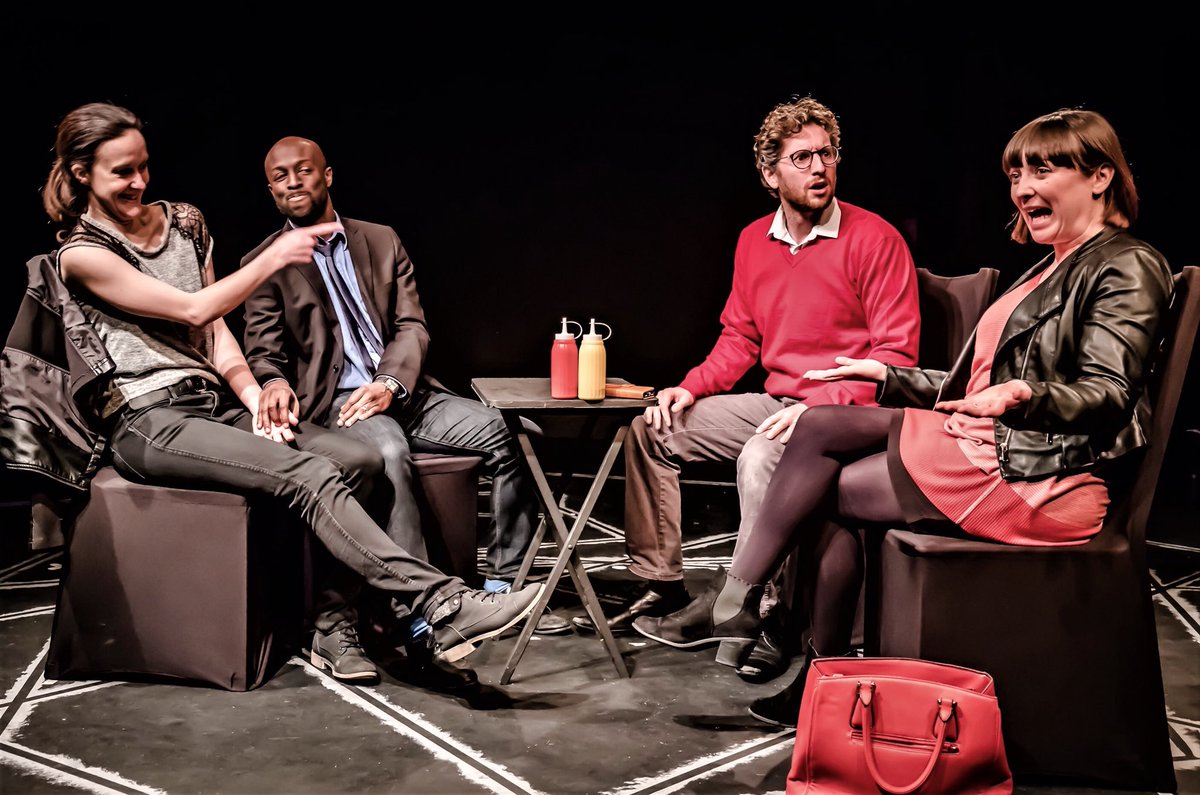
I can’t pretend to know what Kim and Jack, the couple undergoing IVF in Lucy Joy Russell and Holly McFarlane’s play Stuffed, are going through. Having said that, as a childless woman in my 30s (who recently had a heated discussion with a male friend after he made the mistake of saying, in genuine bewilderment, “But don’t all women want kids?”) there are moments in the play that I can relate to a little bit too well.

Red Squash Theatre were most recently seen at the Hen and Chickens in their extremely daft Shakespearean comedy, Macbeeth. Stuffed is quite a different project and given the topic it unsurprisingly feels much more grounded in reality, but it retains a little of Macbeeth‘s delightfully surreal humour – largely in its portrayal of healthcare professionals, for some reason.

Photo credit: Robbie Ewing

These moments aside, it’s actually quite a sad story, about a couple whose desperate need for a baby has taken over their lives to the obliteration of everything and everyone else, and to the point where even they can’t remember why they wanted to be parents in the first place. Every time the IVF fails, they have to deal not only with their own disappointment but also that of friends and acquaintances, whose well-meaning attempts to be helpful and comforting just end up making things ten times worse.

Faye Maughan and Ben Scheck are likeable and convincing as Kim and Jack, but it’s the scenes where their facade of brittle optimism slips and we glimpse the turmoil beneath that they really come into their own. Maughan in particular has a lost, fragile and exhausted look; this is most evident during scene changes, when she lingers aimlessly on stage while the other cast members rearrange the furniture around her.

Also excellent are Dorothy Cotter, as Kim and Jack’s old uni friend Grace, now a mother of three, and Alexander Tol as her husband Colin, a lovable geek with a heart of gold. It’s interesting and refreshing to see that it’s Grace, not Kim, who’s most excited about reigniting their friendship, and a welcome reminder that having children – no matter how much you love them – doesn’t make your life magically complete. Co-writer Holly McFarlane plays a number of roles but particularly stands out as Kim’s mum Frances, the one character who always seems to know exactly the right thing to say. Finally, director Rory Fairbairn completes the cast with a brief, humorous appearance as another friend’s teenage son.

Photo credit: Robbie Ewing

From my own experience I can confirm that this heartwarming and poignant comedy – based on co-writer Lucy Joy Russell’s own experience of IVF – will have women of a certain age nodding in agreement (while also enjoying an excellent soundtrack of 90s tunes from Oasis, Alanis Morissette, Meredith Brooks and more). But as the play shows us only too well, the pressure and desire to have a baby isn’t something that only affects women; Jack’s pain is just as real as Kim’s, yet he often goes unnoticed as everyone falls over themselves to offer his wife sympathy and encouragement. And through Grace and Colin we see the story from the other side – the discomfort of never knowing the right thing to say, but also the sadness of seeing a friend so consumed by the idea of parenthood that they begin to slip away from us. Well acted and a bit of a tearjerker, this little gem of a play is definitely worth a visit.


Can’t see the map on iPhone? Try turning your phone to landscape and that should sort it. I don’t know why but I’m working on it… 😉