Interview: Sean Brosnan, Beau Brummell – An Elegant Madness

Written by Ron Hutchinson back in 2001, Beau Brummell – An Elegant Madness is a black comedy about the downfall of George Bryan Brummell, known as The Beau. This week the play returns to London for the first time in 15 years, opening tomorrow at Jermyn Street Theatre, just a couple of blocks away from Brummell’s commemorative statue.
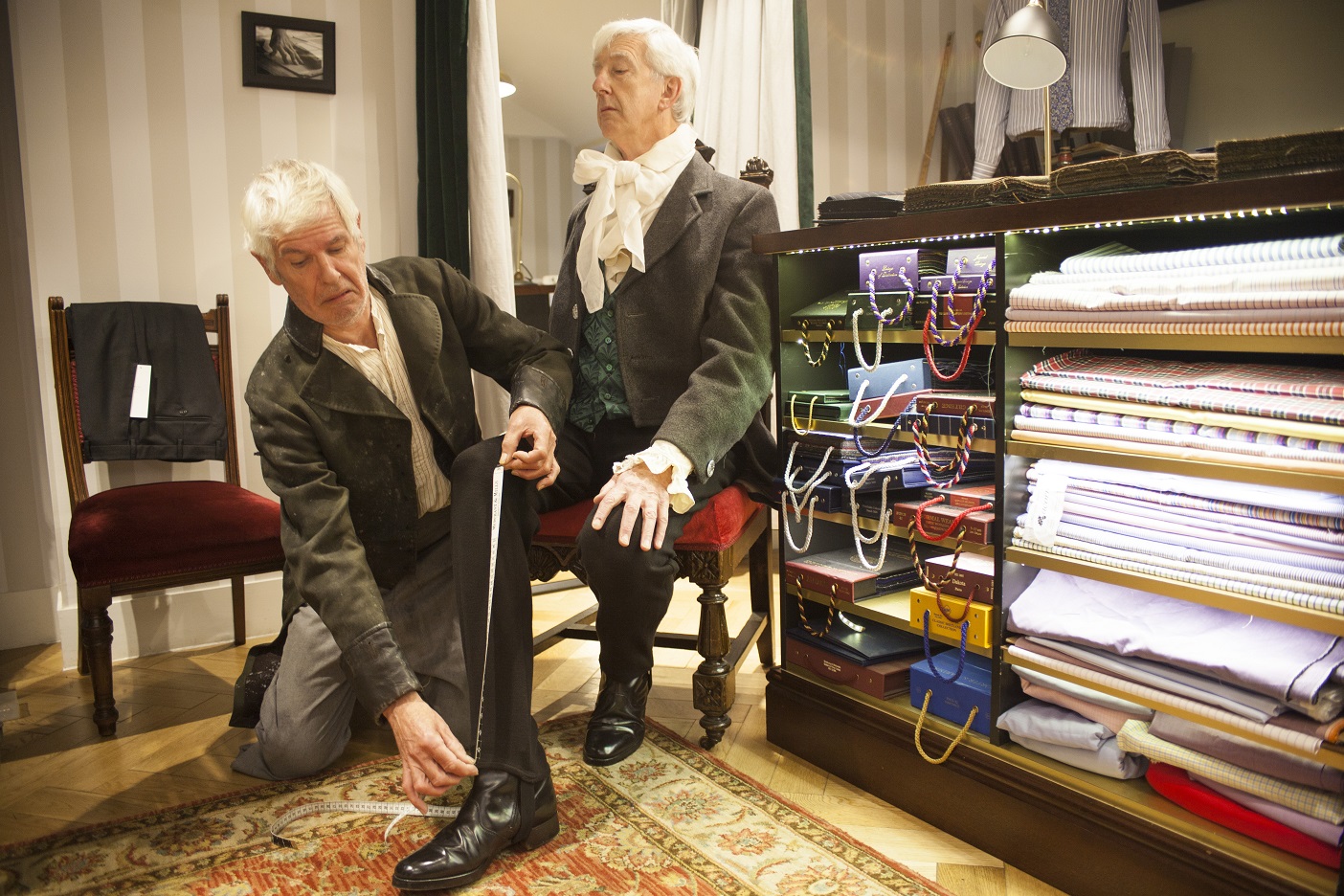
Photo credit: Emily Hyland

So who was Beau Brummell? “The play is a fascinating and amusing insight into the world of ‘celebrities’, featuring the original dandy, wit and revolutionary Beau Brummell,” explains Sean Brosnan, who plays him. “Brummell was in many ways a self made man. He seized opportunities where he could and without concern for the consequences. In fact the more he could pique someone with a barbed comment, the happier he was.

“He bucked the trend in fashion and his influence reigns today in the tailored suit. Without him we may all be flouncing around in overly flamboyant colours and fabrics. Imagine a world of Grayson Perry. Today’s equivalent I would say is a cross between David Beckham for style, Kim Kardashian for fame for fame’s sake, and Stephen Fry for biting wit. Imagine that if you will!”

Set in the winter of 1819, the play finds Brummell living in exile in a madhouse in Calais. He’s convinced his old friend King George IV will come and see him on his visit to Calais – but his valet has other plans. “Beau Brummell has so many facets to his character; joy at his past glory, despair at his current situation and a fascinating, complex relationship with his valet, played with great skill and panache by Richard Latham,” says Sean. “Brummell was unique and playing him at this stage of his life, when he is facing desperate reality but also believing his former glory will be restored, is a challenge and a delight.”

Jermyn Street Theatre, in the fashionable St James’s district, is an appropriate home for the production: “Jermyn Street was at the heart of Brummell’s world. He lived close by and bought his wine at Berry Brothers in St. James Street. With his statue at the end of Piccadilly Arcade he must surely be looking down on us with pride. He has not been forgotten. Playing him here is very special.”

Photo credit: Emily Hyland

Although the play’s set nearly 200 years ago, the story of Beau Brummell remains hugely relevant in today’s celebrity-obsessed world. “Brummell was the most famous man of his day and yet is now largely forgotten. Like Oscar Wilde, he had a spectacular fall from grace,” says Sean. “Even today, one mistake in the public eye, be it ever so small, can bring the media’s wrath and vilification. If you’re famous, watch out. They’re out to get you!”

Sean hopes the play will help bring Brummell’s story to audiences who may never have heard of him. “It’s a play that manages to balance the regency farce of Blackadder III with the grandeur of King Lear and has been called ‘Waiting for Godot for the fashion conscious!’ If our audiences leave feeling they understand a little more about the madness and brilliance of Beau and have had a good chuckle along the way, then I will be delighted.”

Beau Brummell – An Elegant Madness is at Jermyn Street Theatre from 13th February to 11th March.

Review: Crime and Punishment at Jack Studio Theatre

In the centenary year of the Russian Revolution, Arrows & Traps have got in early with their production of Dostoyevsky’s Crime and Punishment. But put aside any off-putting thoughts of epic 600-page novels; this short, sharp adaptation by Marilyn Campbell and Curt Columbus cuts straight to the heart of the story and is all over in a gripping hour and a half.

Focusing less on either the crime or the punishment, instead this adaptation gives us a disturbing insight into the mind of a murderer during the days between the two. By the time the play begins, the murder – of an elderly pawnbroker and her sister – has already been committed, and Raskolnikov (Christopher Tester) finds himself drawn into a cat and mouse game of psychological warfare with police inspector Porfiry (Stephen MacNeice), who’s convinced of his guilt. In desperation Raskolnikov turns to Sonia (Christina Baston), a virtuous young woman forced into prostitution to save her family, who offers his only chance of redemption.

Photo credit: Davor Tovarlaza @ The Ocular Creative

Flashbacks give the audience an opportunity to piece together the events that preceded the murder, as well as the crime itself – but also demonstrate the fractured state of mind of the killer, who himself looks back in an attempt to justify his actions. In the present, Raskolnikov explains to Porfiry that he believes some crimes – including this one – are necessary for the greater good. This is the debate at the heart of Dostoyevsky’s novel, and Campbell and Columbus’ adaptation gets straight down to it, mercilessly axeing several additional characters and plotlines, without losing any of the essence of what the story’s all about.

Director Ross McGregor has assembled a brilliant new cast for this production. Stephen MacNeice is an affable Porfiry, a self-confessed “freeform” investigator whose complex relationship with the suspected murderer begins to feel more like that of father and son than detective and criminal. As Sonia, Christina Baston has a physical fragility that contrasts with the spiritual and moral strength that sustain her – before transforming in flashbacks into the hunched, sneering old pawnbroker who’s about to meet a messy end. But this is ultimately Raskolnikov’s story, and Christopher Tester is captivating as the tormented killer. Despite being a violent criminal driven by his own arrogance, he’s also charming, articulate and capable of great kindness… and so like the biblical Lazarus who’s referenced throughout the play, we desperately want to believe he has the potential for salvation.

Anyone who’s seen Arrows & Traps in action before knows that they have a signature style – but they’re also not afraid to take a risk and step into new territory. Crime and Punishment is the company’s 10th production, and in a lot of ways is quite different to anything they’ve done before, with a cast of just three actors and a running time of only 90 minutes. Yet this is also recognisably an Arrows production, not just in its strong acting performances, but in the use of contemporary music, atmospheric lighting (courtesy of Karl Swinyard) and a dreamlike quality, particularly in movement director Will Pinchin’s exquisite slow-motion murder scene. (I never thought I’d be able to describe watching two old ladies get bludgeoned with an axe as beautiful, but there we go.)

Photo credit: Davor Tovarlaza @ The Ocular Creative

So what we really get with this production is a super-concentrated Arrows experience, stripped back to basics but bearing all the hallmarks of a company and director who know exactly what they’re doing. An intense psychological drama, the play has the entire audience holding our breath throughout, and asks some very real, and relevant, questions about the nature of crime and whether there’s actually any such thing as good and evil.

Think you know Crime and Punishment? Think again.


Can’t see the map on iPhone? Try turning your phone to landscape and that should sort it. I don’t know why but I’m working on it… 😉

Review: Frankenstein at Greenwich Theatre

200 years after Mary Shelley wrote her classic gothic novel, Frankenstein returns to the stage in the skilled hands of Blackeyed Theatre. Adapted by John Ginman, this concise, two-hour retelling is suitably chilling and atmospheric while remaining family friendly, and is executed to perfection by a multi-talented cast of five… or should that be six?

Keeping true to the “story within a story within a story” format of Shelley’s novel, Eliot Giuralarocca’s production is set on the ship of Robert Walton, an explorer to the North Pole, who rescues the exhausted Victor Frankenstein from the ice. Walton becomes fascinated by the mysterious stranger’s story of how, driven by crazed ambition, he built and gave life to a Creature, only to reject it and in doing so, drive it into a destructive cycle of loneliness and despair that ended up costing him everything.

Photo credit: Alex Harvey-Brown

The story, spanning several years, moves quickly – from Geneva to Ingolstadt to London to Scotland, and far beyond – and the cast do likewise. While Ben Warwick is on stage throughout as the wild-eyed, fast-talking, increasingly dishevelled Frankenstein, his fellow cast members are scarcely less busy. Each takes on multiple roles within the story, while still finding time to pop round the back of the stage and bring Ron McAllister’s dramatic soundtrack to life on timpani, cymbals and a variety of other ingenious, home-made instruments.

Act 1 is largely there to set up the story, and is quite science-heavy as Frankenstein describes his studies and his urgent desire to create life. But it’s in Act 2 that the production becomes truly electrifying, with the first real appearance of Yvonne Stone’s life-size Bunraku style puppet. Built from rope and cloth, with blank, staring eyes, the Creature is manipulated so skilfully by the cast, and voiced so perfectly by Louis Labovitch, that it’s genuinely possible to forget the actors are there at all, and to think of Frankenstein’s creation as entirely separate from the other characters they play: kind, beautiful Elizabeth (Lara Cowin), Victor’s supportive friend Henry (Max Gallagher), Walton, the explorer hanging on his every word, but not necessarily for the right reasons (Ashley Sean-Cook), and a multitude of cameo appearances as other minor characters. This is a production that’s about so much more than the impressive individual performances; it’s a seamless ensemble effort that requires everyone to be in exactly the right place at the right time.

Photo credit: Alex Harvey-Brown

Victoria Spearing’s set takes inspiration from the ship on which the story begins and ends, and as Frankenstein narrates his tale, it springs to life from the materials around him. So the sail becomes a river; the Creature is formed from bundles and sacks of old rope and rags; more ropes are transformed into the electric wires that finally give it life. It’s testament both to the actors’ performance and the simple, descriptive style of John Ginman’s script, that without ever leaving the ship’s deck, we find ourselves transported to workshops, stormy mountaintops, courtrooms and even looking out over the quiet beauty of Lake Geneva.

I remember being a bit surprised the first time I read Frankenstein, because it felt a bit tame, not the out-and-out horror I’d been expecting. Similarly, Blackeyed Theatre’s excellent production doesn’t set out to shock us, but instead to send us home with a creeping unease as we contemplate the dangerous implications of arrogant human ambition. Though there’s certainly an element of suspense, the Creature’s crimes (most of which we don’t even see committed) provoke more sadness than fear, while he himself is so human that it’s harder to shrug his deeds off as merely the work of the supernatural – and so ironically it’s humanity, rather than monstrosity, that’s most likely to keep us awake at night.


Can’t see the map on iPhone? Try turning your phone to landscape and that should sort it. I don’t know why but I’m working on it… 😉

Review: Joseph and the Amazing Technicolor Dreamcoat at the Orchard Theatre

When I was 10, my parents took me to see Joseph at the London Palladium. To say I was excited is something of an understatement; for reasons I won’t go into, I was a little bit in love with the star, Phillip Schofield, and it was also – as far as I can remember – my first ever West End show. Ever since, my mum’s enjoyed reminiscing about how I was entranced from start to finish, and so began a lifelong obsession with theatre that led eventually to this very blog.

So it’s fair to say Joseph is a show that holds a pretty special place in my heart. Any chance I’ve had to see it again since has brought back those memories of childlike glee – and Bill Kenwright’s touring production, starring X Factor winner Joe McElderry, is no exception. By the time the curtain rose at the Orchard last night, I was practically bouncing up and down in my seat like the excited ten-year-old of 25 years ago, much to my sister’s amusement. (I wasn’t the only die-hard fan in the audience, either; partway through I noticed someone in the front row with pom-poms.)


For those not familiar with the show, it’s based on the biblical story of Joseph and his 11 jealous brothers. When their dad Jacob surprises his favourite son with a fancy new coat, his brothers beat him up and sell him into slavery (as you do). After various ups and downs, Joseph’s talent for interpreting dreams brings him fame and fortune, and leads him eventually to an emotional reunion with his father and guilt-stricken brothers.

Once the show got underway, it all came flooding back: Andrew Lloyd Webber’s familiar tunes that take us on a world tour of musical styles; Tim Rice’s witty lyrics, including jokes that I’m fairly sure I wouldn’t have understood the first time around; the big, colourful sets with charmingly basic props that put you in mind of a (very) high-budget school play (in the absence of the much-loved turntable from previous productions, Jacob’s inflatable sheep were probably my favourite bit, not least because they needed a bit of help from the cast to stand upright). It also turns out I still know all the words to every song, including the 29 colours of Joseph’s coat, in order – I dazzled my sister with this piece of useless trivia before the show started, and she did a very good job of looking impressed.

Speaking of being impressed, I’d heard good reports of Joe McElderry’s Joseph, and he didn’t disappoint, with powerful vocals and an easy charm. He’s said in interviews that Close Every Door is one of his favourite moments, and it shows – his version is up there with the best I’ve heard. Britain’s Got Talent star Lucy Kay makes a confident musical theatre debut as the Narrator, and Ben James-Ellis has us all rocking and rolling as the Pharaoh; as always, I wished we could have seen more of him.

Photo credit: Mark Yeoman

Knowing a show inside and out can have its disadvantages, and ironically being a super fan probably made me more critical than most… but even so my complaints are few and far between. A couple of the musical numbers, including the one that closes the first act, feel like they’ve been cut short – an odd decision given it’s not a very long show anyway. Act 2 has, for me, lost a little bit of its humour, and one or two of the best one-liners (“it takes a man who knows no fear to wrestle… with a goat” still makes me giggle every time) were drowned out by the music and I suspect anyone who didn’t know the lyric would have missed it.

But I’m nitpicking. Joseph is, as ever, a fun, colourful and brilliantly bonkers night out for the whole family. It may be 25 years since I first saw it, and incredibly almost 50 since it was written, but one thing’s for sure – this is a show that will never really get old, and I have no doubt I’ll still be bouncing excitedly in my seat and embarrassing family members another two decades from now. Here’s hoping, anyway.

Joseph and the Amazing Technicolor Dreamcoat is at the Orchard Theatre until 11th February.

Review: Henry V at Southwark Cathedral

I went in to Antic Disposition’s Henry V with high expectations. Not only was it in a unique and stunning venue – Southwark Cathedral, first stop on the company’s latest UK cathedral tour – but I’d heard amazing things following the production’s earlier performances in 2015 and 2016, and was eager to see if it lived up to its glowing reputation. (Spoiler alert: it totally does.)

In an inspired reframing of Shakespeare’s history as a play within a play, directors Ben Horslen and John Risebero have set the story in a French field hospital during World War 1, where a group of recuperating French and English soldiers, along with two of their nurses, put on a performance of Henry V to cheer themselves up. After a nervy start, they soon ease into their parts so well that both they and we get lost in the story – but reality is never far away, with the unwelcome reminder that there’s a big difference between playing soldiers and actually being one.

Photo credit: Scott Rylander

While the performance of Henry V is excellent, it’s these additional scenes, along with songs based on the poetry of AE Housman, that really make the production stand out and give it such devastating emotional impact. 500 years separate the two conflicts, but while the two nations may now be allies instead of enemies, there’s a tragic inevitability about the end result: ordinary men – husbands, fathers, brothers and sons – losing their lives for someone else’s cause. The conclusion of both Acts 1 and 2 leave us shaken and horrified as we watch grown men crumble before our eyes, and it’s these moments that linger in the memory, far more than the triumphant scenes of England’s victory at Agincourt.

The format also sheds new light on the performance itself. When Henry, played by Rhys Bevan, looks doubtful of his cause, is it actually Henry or the soldier playing him? The love scene between the triumphant young monarch and French princess Katherine (Floriane Andersen) has a touching authenticity when viewed instead as an injured soldier and the nurse caring for him. And the heartbreaking moment when Mistress Quickly (Louise Templeton) waves her men off to battle is reflected later when the two nurses must once again watch their charges march away to an uncertain fate.

The Franco-British cast are uniformly excellent. Rhys Bevan proves a brilliant addition to the company, delivering the big speeches with passion and conviction, but nailing the lighter moments too (it’s no surprise to read in the programme that he’s a comedy performer). Dean Riley is a beautifully brattish Dauphin; Stephen Lloyd shows his versatility as timid Nym and bold, outspoken Williams and Westmoreland; Adam Philps is devastating as the shell-shocked soldier playing Bardolph; Floriane Andersen and Louise Templeton are a joy to watch as both the dedicated nurses and the giddy Princess Katherine practising English with her lady in waiting Alice. I could go on…

Photo credit: Scott Rylander

The actors also prove themselves to be talented musicians, and their performances of Christopher Peake’s songs are spine-tingly beautiful, not least because they highlight the key emotional moments of the production. The poetry of AE Housman predates World War 1, but is nonetheless brutally candid about the horrors of conflict, and the words are a fitting accompaniment to Shakespeare’s text. The majestic cathedral setting is also a perfect fit (though it does suffer from occasional acoustic issues), giving new significance to the role of faith in times of war; even the less than temperate conditions inside feel appropriate for a field hospital.

This is the third year in a row that Antic Disposition have performed their Henry V, and having finally had a chance to experience it, I understand why audiences have been so happy to see them return. Entertaining, poignant and unforgettable, this is a production and performance that I suspect will stay with me for a long time. Catch it if you can.


Can’t see the map on iPhone? Try turning your phone to landscape and that should sort it. I don’t know why but I’m working on it… 😉