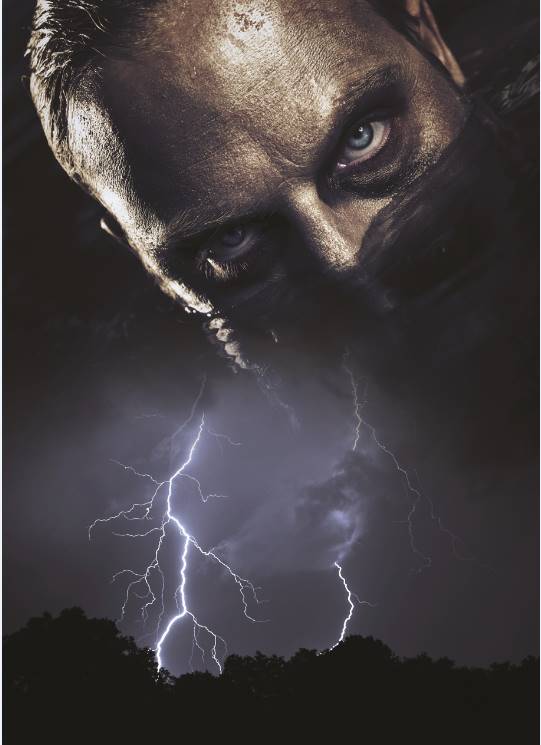
Review: The Gospel According to Philip, Theatre N16

For Arrows & Traps, known for their popular adaptations of Shakespeare and other classic works of literature, The Gospel According to Philip is unfamiliar territory. A brand new comedy written by Richard Melchior and Heidi Svoboda, the play couldn’t be more different to the company’s last two shows: a bloody and politically charged Macbeth, preceded by a gripping adaptation of Tolstoy’s epic novel, Anna Karenina.

So, a bit of a gamble perhaps for Arrows director Ross McGregor, but did it pay off? Absolutely.
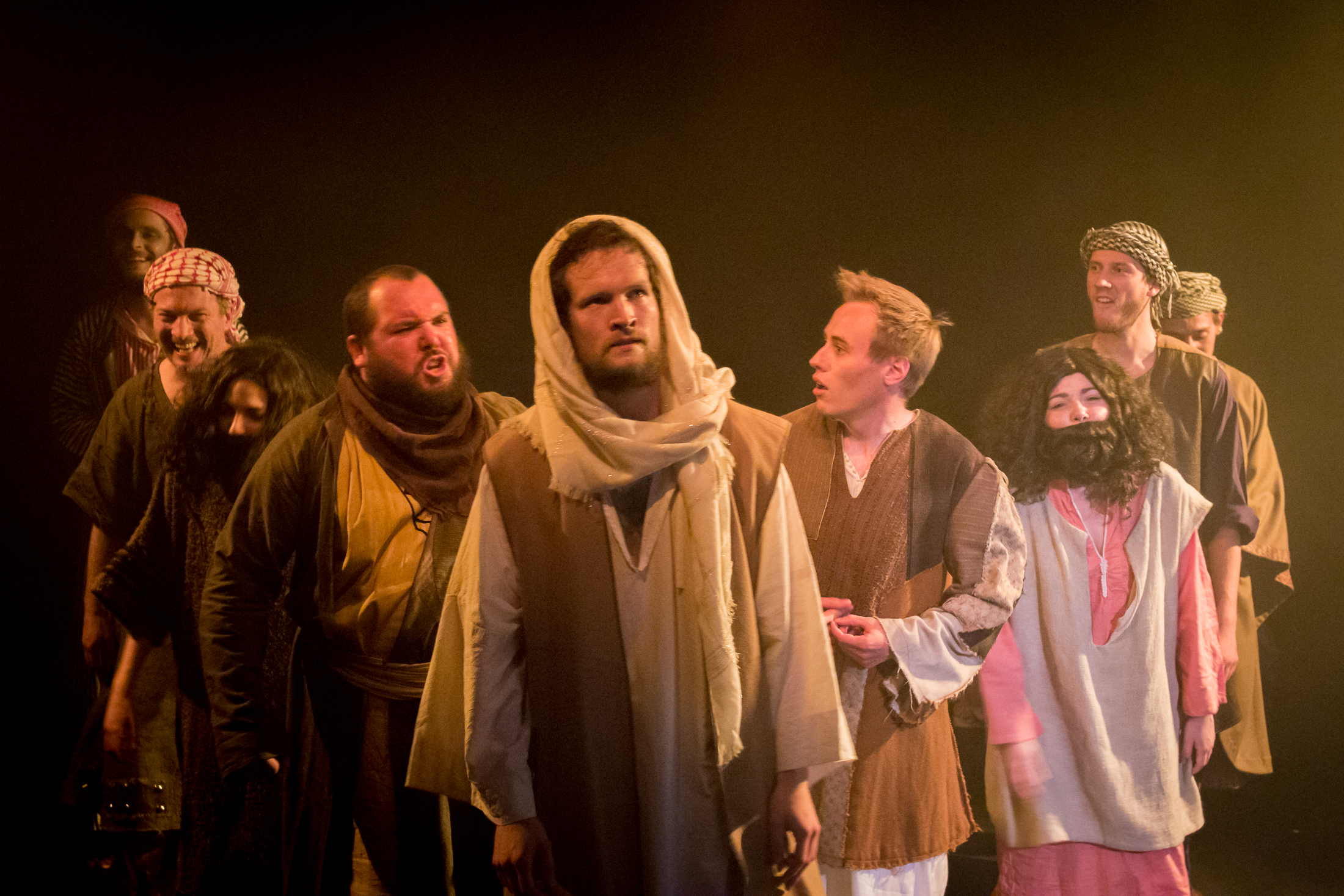
Photo credit: Davor Tovarlaza
To be more exact, The Gospel According to Philip left me wondering why it took Arrows & Traps so long to tackle their first outright comedy. Not to mention giggling all the way home over the brilliantly bonkers dance routines. (If you need only one reason to see this show, make it the unforgettable sight of Jesus Irish dancing. You’re welcome.)

The play is an irreverent re-imagining of the story of Jesus and his disciples, leading up to the crucifixion, all set down in often quite unnecessary amounts of detail by Philip, the newest member of the gang. Will Mytum, who plays the eager apostle, is irresistible from the moment he steps on stage – even before he opens his mouth, he has us laughing with his earnest expression and childlike excitement… and he only gets more adorable as the play goes on.

As in previous Arrows productions, every member of the cast excels, with most of them taking on multiple roles, and all proving themselves to be gifted comedians. Adam Elliott is full of charisma as bad boy Judas, while Elle Banstead Salim is a whirlwind of energy as feisty chatterbox Mary Magdalene (and also puts in a couple of fantastic cameos as a bride upstaged by Jesus at her own wedding, and Pontius Pilate’s Catherine Tate-inspired receptionist). Alex Stevens has perhaps the most challenging role as Paul, whose wildly homophobic language only thinly veils his private confusion and vulnerability. And then there’s Jesus, played by Pearce Sampson, master of the beatific smile, albeit often through gritted teeth, who grows increasingly frustrated as the disciples persist in asking awkward questions he can’t answer.

Photo credit: Davor Tovarlaza
Which brings us to the message at the heart of a play that’s undoubtedly very funny, but has a serious point to make as well. In a scene that even the script acknowledges is a bit preachy and makes everyone uncomfortable, a smiley, likeable Devil (Olivia Hanrahan-Barnes) paints a vivid picture for Jesus of the bleak future ahead, in which human beings will commit acts of horrifying violence in the name of their faith – but even this can’t deter him from the path laid out for him. Later, Jesus asks Matthew Harrison-James’ Geordie-accented God (who has a few issues of his own to work out) why he has to die in such a horrific way, and – while clearly dissatisfied with the response – goes ahead and does it anyway, because that’s The Plan.

Perhaps it sounds like Melchior and Svoboda’s play is anti-religion, or out to cause offence. It’s true that it plays fast and loose with the Bible as we know it – although I must admit I quite enjoy the idea that the Last Supper might have consisted of crisps and rum instead of bread and wine. But ultimately, the unexpectedly sombre final speech of an older, wiser Philip is one of acceptance. Some people have faith; some don’t, and ultimately it doesn’t really matter – as long as we exercise caution. Believing something just because “it is written”, without question, is just as dangerous as believing nothing at all – and that’s a rule that could be applied to all kinds of things, not just religion.

The Gospel According to Philip is witty, cheeky, sometimes very silly and ultimately pretty challenging. And it’s been brought to life for the very first time by a company who, it seems, can turn their hand to just about anything. Including Irish dancing, apparently.


Can’t see the map on iPhone? Try turning your phone to landscape and that should sort it. I don’t know why but I’m working on it… 😉

Interview: The Two Bit Classics, Pride and Prejudice

It’s one of the world’s most popular love stories, the ultimate boy meets girl romantic comedy. Pride and Prejudice, written by Jane Austen in the early 19th century, has been adapted countless times for stage and screen, in many different ways – but perhaps never quite like The Two Bit Classics’ production, which is about to return for a second UK tour from October. Joannah Tincey’s adaptation features just two performers: Jo herself, and her husband, Nick Underwood.

Pride and Prejudice - UK Tour

The unique production was last staged in 2014, when it was described by A Younger Theatre as “a delightful little gem of theatre that pulses with comedy and energy”. As the company prepares to tour again, Nick explains, “We decided to bring the show back because people enjoyed it so much the first time! We had so many wonderful emails from people, many of whom wanted to see it again. We love playing the show, we enjoy working together. It’s a great fit all round.”

Pride and Prejudice has brought us some of literature’s most iconic characters, from the romantic to the ridiculous. “The characters are immediately recognisable, fallible, funny and engaging,” says Jo. “Austen creates these fully fleshed characters, full of strengths and weaknesses. We recognise ourselves in there somewhere, I think.”

But does a cast of just two actors mean we only get to enjoy two of these brilliant creations? “Definitely not!” says Jo. “21, in fact,” clarifies Nick.

Jo explains what inspired her unique adaptation: “I’d been doing a lot of work as an actor on various multi-role style productions – including some Shakespeare and Dickens. Each time I was involved in one, it struck me how clear the language becomes when you have to use it to tell an audience who you are and what you want (when you’re changing characters from moment to moment, that’s important!). I love Austen’s wonderful language and wit and it struck me that here was a way to bring it to life theatrically.

Pride and Prejudice is such a wonderful story and there are so many double-acts within it: Jane and Lizzy, Darcy and Lizzy, Mr and Mrs Bennet, Lydia and Kitty, Bingley and Darcy…”

“All the words we say are ones that Austen wrote herself,” adds Nick. “Jo didn’t need to invent dialogue. Characters use Austen’s text, we talk to the audience in character, and our job is to grow that relationship each night. It’s a really immediate and exciting way to work.”

Bringing to life so many characters with just two performers naturally presents quite a challenge. “An actor’s job is to find the truth in every character, otherwise we’re wasting an audience’s time,” Nick explains. “That doesn’t mean characters can’t be funny, but we aren’t sending them up in any way. If this was two hours of silliness, people would get bored. This is two hours of pure Austen. As for other challenges, well, you need to be pretty fit to play 21 characters between the two of you…”

Photo credit: Carrie Johnson

Unique it may be, but die-hard fans of the novel need not fear – The Two Bit Classics’ production remains completely faithful to Austen’s original. “The straightest form of the story is the novel of course, and any adaptation will offer a different experience from that,” says Jo. “Screen adaptations or more traditional stage adaptations usually need to invent dialogue – because Austen didn’t write a script! There’s always something new in there. Our take is two actors, but our language is as pure as it gets.”

Both Jo and Nick agree what excites them most about this second tour is new audiences for their show, and a fresh chance to play the story each night. “The audience are a part of the show, as it’s their imagination and response to our story-telling that brings the show alive,” says Jo. “We want them to go away having actively experienced the story of Darcy and Lizzy, having heard and felt the brilliance of Austen’s writing in a way that is really immersive.”

Nick concludes, “I hope they go away having laughed and having been moved by the brilliance of Austen’s story and characters.”

Pride and Prejudice opens at Preston Guild Hall from 6th-8th October and all tour dates can be found at www.pandptour.com.

Interview: John Ginman, Frankenstein

2016 is the 200th anniversary of Mary Shelley’s Frankenstein, and critically acclaimed Blackeyed Theatre are marking the occasion with a brand new adaptation of the classic horror story. The production, directed by Eliot Giuralarocca, will feature Bunraku-style puppetry designed and built by Yvonne Stone, with live music composed by Ron McAllister – and sees the company reunite with John Ginman, who wrote their hugely successful adaptation of Bram Stoker’s Dracula in 2013.

“It’s refreshing to work again with such a talented team who have a commitment to high standards,” John explains. “Blackeyed Theatre’s work keeps evolving but the key ingredients are always the same: a passion for distinctive live theatre, strong creative leadership, a company of multi-skilled performers, and a determination to take bold, innovative live shows to audiences throughout the country.”

Frankenstein, Blackeyed Theatre

In 1816, nineteen-year-old Mary Shelley composed the first draft of Frankenstein as part of a writing competition with Lord Byron, John Polidori and Percy Shelley, during a wet summer’s stay at Lake Geneva. Two centuries later, her novel continues to both fascinate and horrify readers and audiences across the world. But how can we explain this enduring popularity?

“It’s partly a matter of genre,” John suggests. “Gothic fiction has been popular with readers for more than two centuries – though it’s fair to say that Frankenstein has reached its largest audiences through its numerous stage, and later film, adaptations. In writing Frankenstein Mary Shelley has created a powerful new version of an ancient myth. Its narrative seeks unashamedly to ‘chill the blood’, which readers and audiences love. However, the story engages us even more deeply because it still poses questions that challenge us. Should we limit what scientists are allowed to research, in an age when boundaries to knowledge no longer seem to exist? And how can we ensure that we take responsibility for the discoveries we make?”

As with any classic work, adapting Frankenstein was not without its challenges: “The key challenge is to translate a 200-page novel into two hours of theatre for audiences who may or may not be familiar with the book. You have to be selective and identify what’s essential in terms of story, character, tone and themes. The bottom line is that the story has to be clear. It also has to work as theatre, and you have to achieve this with images, space, sound and rhythm, of which the spoken words are also a part. You have to remember that as you are writing.

“The other challenge is to honour the novelist’s vision. In this case I wanted to put on stage the important aspects of the novel that are often excluded in adaptations. We’ve used Robert Walton’s story as a frame to focus the whole action, which allows The Creature to tell the story from his point of view – it’s clearly important to Mary Shelley that we understand how he thinks and feels.

“It’s also wise to be aware of any shortcomings the book might have. In this case, surprisingly perhaps, the female characters have less depth than the men, and I’ve worked to give more substance to Elizabeth, in particular.”

John reflects on his previous collaboration with Blackeyed Theatre back in 2013: “Dracula confirmed my sense that you can achieve almost anything in a live show with very simple theatrical elements, and that you have to trust the skill and versatility of the performers to create the effects you need. The script is like a musical score and so really comes to life when it’s being performed. Also, I noted the hunger of audiences for powerful live theatre in venues large and small the length of the UK, and that’s been very encouraging.”

In a unique and exciting twist, the production will feature a full-size 6’4″ Bunraku-style puppet, which needs up to three people to manipulate it. It’s been designed and built by Yvonne Stone, who’s working with Blackeyed Theatre for the first time, and whose previous credits include Warhorse and His Dark Materials for the National Theatre.

What does John feel this use of puppetry adds to the play? “That will be for the audience to say! Puppets can be remarkably expressive and add more dimensions to the experience of a live show. Bunraku has a wonderful, long tradition in Japanese theatre, but we’re using its techniques here in a completely contemporary way.”

Audiences across the UK will have the opportunity to see the show as it embarks on an extensive tour later this month, taking in over 30 venues before Christmas and additional locations in the spring. “My chief hope is that the audience will enjoy a powerful two hours of theatre, something quite distinct from watching a film version, for example,” concludes John. “I also hope that they will realise there is much more to the novel than the familiar horror story about a crazed scientist.”

Frankenstein opens at Wilde Theatre, Bracknell, on 22nd September. Full tour dates and ticket info can be found on Blackeyed Theatre’s website.